Hi! I’m Sheila, the Upper School Head of Division (HOD) and Assistant Head of School (AHOS) at BASIS International School Nanjing. I’d like to share about my career pathway at BASIS International & Bilingual Schools • China (BIBS• C), what it means to be a leader here, and my advice if you think you might want to join BIBS• C leadership.

Career Progression
I started off at BASIS International School Shenzhen as the High School Head of Division (HOD). I appreciated the opportunity to work at the flagship campus because, besides being able to work with an amazing team that I’m still close with, I learned all the BASIS International & Bilingual Schools policies and procedures. When I shifted to the Upper School HOD role at BASIS International School Nanjing two years ago, I was able to bring that knowledge with me to help improve the school’s procedures.

BASIS International School Shenzhen
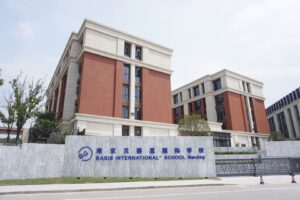
BASIS International School Nanjing
Now whenever I have a question, I just message my friends at the Shenzhen campus or in the Chief Executive Head of Schools (CEHOS) office, which is also located on the same campus. When I do that, I’m not emailing a colleague I’ve met once at a training; I’m touching base with a close friend.
This year, in addition to being the Upper School HOD at BASIS International School Nanjing, I have the privilege of taking on the Assistant Head of School (AHOS) role. As AHOS, I support all-school learning in departments like ICT and Chinese, support our all-school counselors, and mentor our Director of Student Activities, who manages our after-school activities.
I also manage the library, which is a real treat, as I was a librarian at two different international schools before becoming a school administrator. It’s rewarding to coach and support the librarians as they take on some big projects for our campus, like the Korean reading corner, family Fridays in the library, and special events. I love the AHOS role because I’m able to give back to the whole school rather than just the Middle and High School divisions.

I’m also proud of the work I’ve done on several BASIS International & Bilingual Schools network committees. In my first year, I worked on the Capstone and Electives Committee, which created “best practices” procedures around our Elective and Capstone classes, as well as our Senior Projects. Last year, I worked on the Aligned Texts Committee; I helped decide the common texts that would be used in all BASIS International & Bilingual Schools • China Upper School English classes. This year I’m working on AI trainings for school leaders. It’s fulfilling to be able to point to specific ideas and decisions I made that now impact thousands of students in a positive way.
What it Means to be a BASIS International Schools Leader
At BASIS International & Bilingual Schools • China, I focus more on instructional and curriculum leadership than I did at previous schools. This focus on teaching was part of what attracted me to leadership at BIBS• C. I got into school administration because I wanted to help teachers, not because I wanted to work on departmental budgets and duty schedules. Because our fantastic Operations team handles many of the tasks that I managed at other schools, I have more time to focus on my passion, which is supporting teachers and students.

Another thing that sets BIBS • C leadership apart is that many academic leaders teach classes. Being in the classroom with students means that we learn firsthand about what works and what doesn’t. It’s great for my instructional leadership, as I can try out new teaching strategies or approaches before recommending them to teachers.

What matters most to me is staying connected to the students; teaching allows me to do just that. I love the moments when I see kids from my class in the halls. Coaching middle school girls’ soccer has also been fun (I couldn’t resist their puppy-dog eyes when they asked me to coach!). At BASIS International & Bilingual Schools • China, I get the best of both worlds—leading while still teaching.
My Leadership Approach
My leadership style is about setting a clear direction, then giving people the space to achieve it in their own way. I establish deadlines and parameters, communicate directly, and ensure documents and procedures are clear and accessible. With our teachers coming from diverse countries and systems, I focus on clarity of systems so everyone understands our shared goals.

Our Director of College Admissions described me as “boots on the ground,” and that resonates. I’m constantly in classrooms, out and about on campus, and meeting with students, teachers, parents, and members of the Operations team. I didn’t get into education to sit at a desk, and I like being involved in helping as many people as possible.
Gratitude is a big part of my leadership practice. The whole first page of my weekly newsletter to teachers is all “thank yous” and celebrations. I make sure each teacher gets a handwritten note a few times a semester that thanks them for something special they’ve done and for being on our team. I think candy and flowers are a love language. None of what I do comes close to showing enough appreciation for what teachers do in and out of the classroom, but I try my best.
Network Collaboration
BASIS International & Bilingual Schools • China leaders collaborate and support each other through network-organized initiatives like the Summer Institute, Institute for Management Training (IMAT), and monthly roundtable meetings. In these settings, we unpack problems of practice and figure out solutions together.

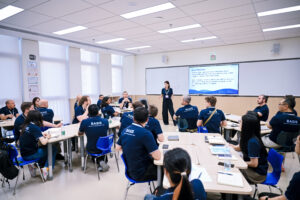
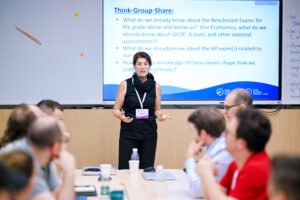
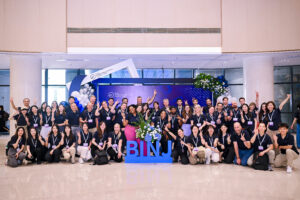
Outside of the network-organized collaboration and support, the HODs and VHODs have our own self-organized ways of helping each other. For example, we have WeChat groups where we share ideas, debate issues, and help each other understand the intricacies of different procedures and protocols. We share a lot of campus-created documents so that we can align our practices and help each other when one of us encounters an issue that isn’t common enough to appear in any policy documents. There are also some informal book clubs. Several of the HODs have done external trainings together during breaks. It’s a tight community.
There’s also a lot of outreach to new HODs to make sure they know what’s on the calendar throughout the year and what they need to do to get their teachers ready. I’ve volunteered in the past to do monthly calls with new HODs to offer peer support; those HODs have, in turn, supported more recently hired HODs in the same way. The result is that there’s often a community feeling among the leadership teams because at some point, everyone has given and received help from all the other schools. We all depend on each other.
Professional Support System
The professional training and support that I’ve received has mainly been through relationships. Workshops and trainings only go so far; they bring us together, but the real support comes afterwards when I’m having conversations with people who challenge my thinking and extend me. I love it when a critical friend tells me I’m wrong, as they’re probably about to teach me something.

In terms of support, the BASIS International & Bilingual Schools • China leadership community has become the most impactful professional learning community I’ve ever been part of. I have BASIS friends who read professional literature with me, who are there for me when I need to talk about a bad day, and who also celebrate my successes as much as they celebrate their own. They’re there for me intellectually as well as emotionally.
For example, during the comprehensive exam week my first year at BASIS International School Nanjing, one of my closest colleagues at another BASIS International & Bilingual Schools school displayed my school’s daily exam results on his whiteboard alongside his own. He wanted to celebrate and encourage my teachers and students just as much as his. Colleagues would stop by his office to check on both schools’ progress and even cheer, “Go Nanjing!” Moments like this highlight the depth of connection and support that exists across our campuses.
My Advice for Teachers Interested in Moving into Leadership Within BASIS International & Bilingual Schools
My advice for teachers who are interested in moving into leadership at BASIS International & Bilingual Schools • China is to keep putting their hands up to lead on their own campuses. When I’m considering potential Chairs, I’m looking for great classroom practices and to see who is already going above and beyond the role of a classroom teacher. When considering potential VHODs, I’m evaluating the extent to which a Chair already drives faculty learning in their department. I’m going to consider the extent to which they made a positive difference in teaching and learning in their department.
While BASIS International & Bilingual Schools • China does provide ongoing leadership training and support, most leaders also have degrees in educational leadership. Having a degree in educational leadership often shows a seriousness about their leadership practice. The HODs and VHODs who I respect the most are also the ones who engage in continual professional reading and reflection. I love hearing someone say, “I used to think… but now I think…” when talking about their leadership practice—or anything else. It shows great mental agility and open-mindedness.
Sheila Seiler
Assistant Head of School
Upper School Head of Division
BASIS International School Nanjing
For more information about teaching abroad with BASIS International Schools, visit our careers website.
Watch the recording of our live webinar about teaching at BASIS International School Nanjing on our YouTube channel.
