Your resume is often your first impression–and in many cases, your only chance to get a foot in the door. Our recruiters receive thousands of resumes every year, from teachers of all curricular backgrounds, experience levels, and countries. And every day, we receive resumes that could use a little extra guidance, and some that are superstars. Common themes often emerge of what works best, and what can be a barrier to making that positive first impression.
Whether you’re applying for teaching roles, leadership positions, or transitioning to a new school or system, these foundational resume tips can dramatically improve how your application is received.
Don’t blindly follow a resume template
Templates can be helpful starting points, but they shouldn’t dictate your entire resume. Many templates prioritize design over substance or hide important information. Use a format that best showcases your experience, strengths, and career trajectory–not one that forces you into awkward sections or unnecessary content.
Present your career history in reverse chronological order
Your most recent experience is usually the most relevant. Listing your roles in reverse chronological order helps hiring managers quickly understand where you are now and how your career has progressed over time.
While your past experience absolutely matters, recruiters and hiring managers are especially interested in what you’ve been doing most recently. Placing your current or most recent role at the top of your resume helps us quickly understand your present responsibilities, skills, and growth. From there, we can easily work our way back through your career journey and see how your experience has evolved over time.
– Hayley Ferguson, International Recruiter
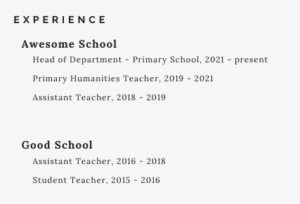
Group promotions or multiple roles at the same organization
If you’ve held multiple positions or earned promotions within the same school or organization, list them under one employer. This shows growth and progression while keeping your resume clean and easy to follow.
Tailor your objective statement (or leave it out altogether)
Generic objective statements, i.e. “To obtain an international teaching job,” rarely add value. If you choose to include one, tailor it specifically to the role and school you’re applying for. Otherwise, it’s perfectly acceptable to omit it and let your experience speak for itself.
Limit it to 2-3 lines that clearly align your experience with the position. Think of it as a snapshot of value, not a biography.
– Natalie Ortega, International Recruiter
Include a concise summary of courses or subjects taught
Especially for educators, a brief summary of the classes, grade levels, or curricula you’ve taught provides helpful context. Keep it high-level and relevant, this isn’t the place for full syllabi. But when appropriate, highlighting an example of a meaningful project or assignment can give recruiters a glimpse into your teaching style.
Focus on accomplishments, not just responsibilities
Instead of listing what you were tasked with, highlight what you achieved. Quantify results when possible and emphasize impact: student outcomes, program growth, leadership initiatives, or instructional improvements.
Highlight certifications, training, and professional development
Go beyond job titles. Call attention to certifications, workshops, leadership training, curriculum work, and professional learning experiences that strengthen your candidacy and show continued growth.
Address prolonged gaps in your career
If there’s a significant gap in your work history, it’s better to acknowledge it than ignore it. A brief explanation–whether for family reasons, further education, or personal growth–helps provide clarity and avoids unnecessary assumptions.
Career gaps are more common–and more acceptable–than many candidates realize. We’re going to ask about them anyway, so it’s helpful to include brief context directly on your resume. Maternity leave, caring for a family member, further education, or other life events are normal. Providing that clarity helps us move forward with confidence rather than speculation.
– Laila Oskouie, Director of International Recruitment
Show what makes you passionate about teaching
Your resume should reflect not just what you’ve done, but why you do it. Whether through leadership roles, extracurricular involvement, or innovative classroom practices, demonstrate your commitment to education and student growth.
Proofread carefully — no typos
Typos and grammatical errors are one of the fastest ways to undermine an otherwise strong resume. Proofread multiple times, read it aloud, and ideally have someone else review it as well. Attention to detail matters, especially in education.

Prioritize readability and clean formatting
No matter how strong your experience is, it won’t matter if your resume is hard to read. Use consistent formatting, clear headings, bullet points, and adequate spacing. A hiring manager should be able to scan your resume quickly and understand your story at a glance.
Make your education section easy to find
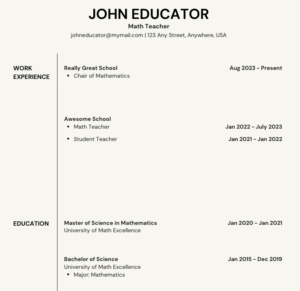
Degrees, certifications, and licensure should be clearly labeled and easy to locate. Hiring teams often scan resumes quickly–don’t make them hunt for critical qualifications.
Don’t just put “Bachelor’s degree”–tell us what you studied!
– Megan Link, Recruitment Coordinator
Always include clear contact information
This may seem obvious, but missing or outdated contact details still happen. Make sure your email address, phone number, and (if relevant) LinkedIn profile or portfolio links are current and professional.
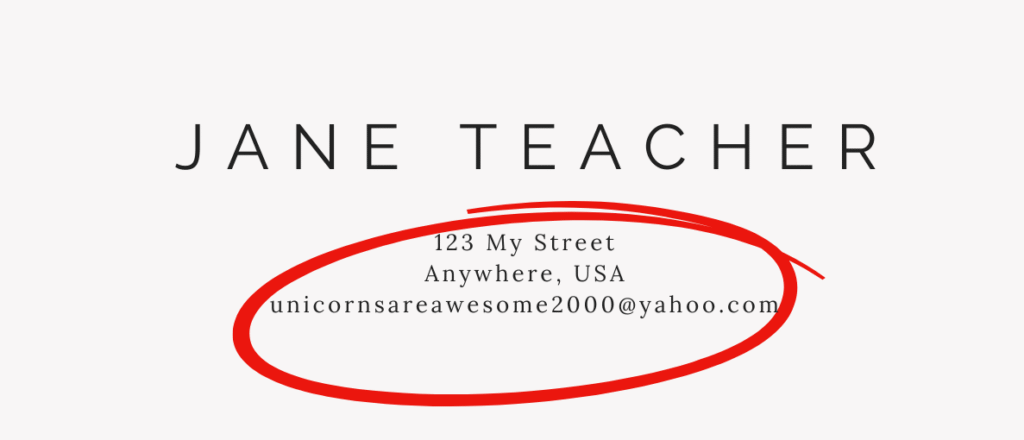
To ensure you aren’t missing emails from interested hiring teams, I recommend using the same email for all of your applications! Another best practice is to ensure your email address is professional and related to you (such as first/last name, initials, subject, etc.). Recruiters and hiring managers may have a laugh at an email address you made freshman year of college, but as a candidate, you may not be taken seriously.
– Danielle LeBlanc, International Recruiter
Modern Updates
Today’s schools are looking for educators who can thoughtfully integrate technology into the classroom. Use your resume to show how you leverage digital tools to enhance learning–whether that’s learning management systems, assessment platforms, data tracking tools, AI-supported instruction, or virtual collaboration. Focus on purposeful use of technology that improves student engagement, differentiation, and outcomes, rather than listing tools without context.
Other Resume Tips From Our Team
Your resume tells your story as an educator: who you are, what you’ve taught, where you’ve been, and why you teach. Sometimes the parts of your story outside the classroom can give insight into who you are inside the classroom. If your personal interests and passions could be of benefit to the school community, it can be helpful to share them in your resume.
I like to see after-school activities because this shows the teacher’s interests, especially if it’s a club unrelated to the teacher’s content area. For example, I was an English teacher but I also hosted American Sign Language club and Girl’s on the Run. Think about how else you contribute to your school community and make yourself look wholistic.
– Heather Polonsky, International Recruiter
I actually love seeing hobbies and interests on a resume–even when they’re not directly related to the role. Cycling, jiu-jitsu, photography, web design, kayaking, cross-stitching…these details humanize you. They show that you’re a well-rounded person with passions beyond the classroom and hint at how you might contribute to a school community in unexpected ways, whether that’s through clubs, activities, community building, or simply being an engaged colleague.
– Laila Oskouie, Director of International Recruitment
Informative, clear, and polished. The best resumes are all three. Keep these tips in mind when crafting your resume and you’ll have the best opportunity to make a good impression when your resume lands in the next recruiter or school’s hands.
Learn more about teaching with BASIS International Schools on our careers website.
