Every August, the world’s largest performing arts festival takes over Edinburgh, as thousands of performers and artists take to stages across the city to present their work. This summer, six students from BASIS International School Shenzhen took part in the Edinburgh Festival Fringe, performing Almost A, an original comedy they devised as part of their Capstone Theatre class.
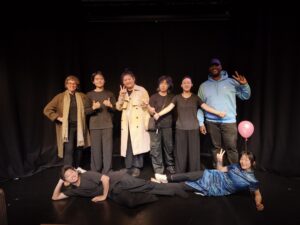

“This was a truly extraordinary experience,” says Lisenka Burger, Senior Chair of Fine Arts and drama teacher at BASIS International School Shenzhen. “Beyond the fact that the city is breathtaking and the energy pulls you in because of the Fringe, there could not be a better way to be exposed to the experience of being a professional actor than performing at a festival like this. There were disappointments throughout the week, but also celebrations. These students have worked alongside me since fourth grade. We have cried together and celebrated their utter commitment to theatre. I would not have wanted to go on this journey into the unknown with anyone else.”
Devised theatre, in which students collectively build a show’s plot, characters, and script rather than performing existing material, has become part of BASIS International & Bilingual Schools • China’s drama program. “It has become a crucial part of the Network’s theatre teaching philosophy,” says Burger. “It brings together plot and character creation, audience perspective, and script writing, and most importantly, students bring something of themselves and what they’ve learned to the stage.”
Below, in their own words, the students share what the week was like, from the chaos of the first show and performing in a non-traditional venue to exploring the colorful city and watching shows that gave them new ideas.
A Highland Fringe Experience
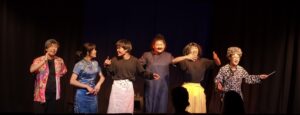
A Princeton lawyer daughter. Noodle cart son. Foreign fiancé with a “love” tattoo that means “cancer.”
Almost A—the stereotypes are almost right. The family is almost normal. The comedy is anything but.
A newly devised comedy performance by the BASIS International School Shenzhen Capstone Theatre class had the opportunity of a lifetime to experience what few professional actors get to experience. They had a chance to perform in the world’s original and largest fringe festival.
The Edinburgh Festival Fringe originated in 1947, when artists not officially invited to participate in the Edinburgh International Festival staged their shows on the ‘fringe’ of the festival.
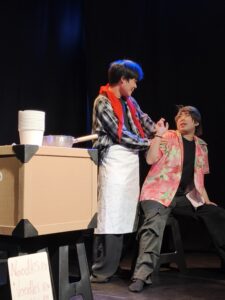
In the final scene of this five-scene one-act farce, written and devised by six students on their way to their first international professional performance, Mei screams, “He’s so passionate! He’s a boy!” The main character, Jade, comes to the realization that she will never be accepted like her brother because she is a girl. The scenes leading up to her epiphany explore stereotypes about being Chinese and also being a foreigner in China. It also explores the way that we deal with these stereotypes, how Chinese families deal with conflict, and how they overcome it.
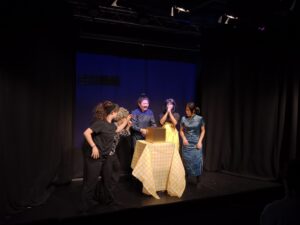
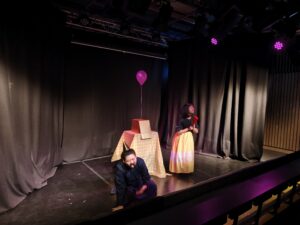
For an hour a day, for five days, Almost A took the stage. We were stoked. We got up. We ate a healthy breakfast (in this case, a Scottish breakfast), put on our wigs, and walked 20 minutes down to theSpace @ Surgeon’s Hall in the Fleming Theatre.
But the real story was what happened once we got there on stage, off stage, and everywhere in between.
The first performance? Chaos. Janice T. doesn’t sugarcoat it: “The first performance was really confusing. We had no idea what the venue was like, and even after we moved into the venue, we weren’t familiar with the environment at all. I yelled, ‘Where is my wig!?'”
“We had a very limited amount of space for performance. It was a small, rectangle-shaped area, and the lights and curtain were temporarily set up for the Fringe,” says Vivian X.
“It was really valuable that we were able to perform and experience shows in non-traditional venues; they weren’t ginormous theaters with elaborate tech, but rather simple, concise, cut-down versions for simple and professional shows,” says Ryan X. “I thought that was really cool to experience.”
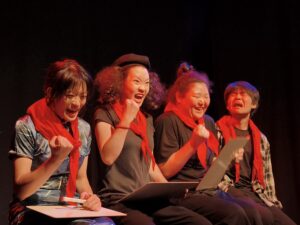
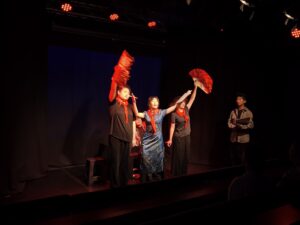
For Aimee X., the real test wasn’t just the lines; it was the space. “We got the opportunity to act as professionals and perform to an unfamiliar audience in a foreign country where they might not understand our puns and jokes in a way that we expect them to,” she explains. That uncertainty, she adds, became part of the thrill.
For Chris X., the Fringe offered something rare: genuine engagement. “It’s so nice to be in an environment where everybody is passionate about drama, passionate about their own work, and passionate about your work,” he reflects. “People would come to your stuff at the Fringe, and people would actually care about the art of it, listen to it, analyze it, and try to be immersed in it.”
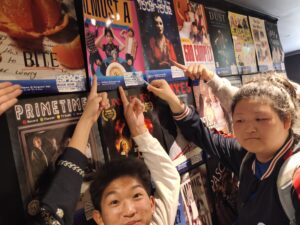
“I really like the ways various performers advertised their shows. They are creative: street performances, drumming, weird costumes, and short tap-dancing excerpts. All of them are eye-catching and intriguing.” That’s Susana Z., describing the Fringe’s chaotic, colorful street-level marketing.
Brent Bell, drama teacher at BASIS International School Shenzhen, who accompanied us to Scotland and served as technical director, also thought, “There is no greater experience than being able to do lights and sound for a live show with an unknown audience. It was an amazing and humbling experience to pass out flyers attempting to bring people into our show. There really is no greater teacher than life experience in live venues. I was so happy to be a part of it.”
Inspiration Beyond the Stage
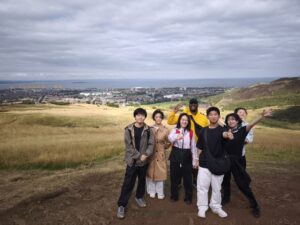
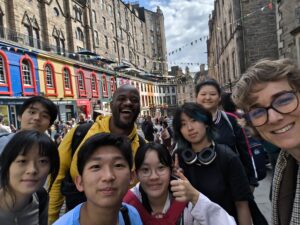
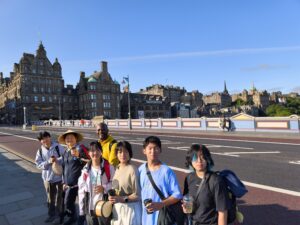
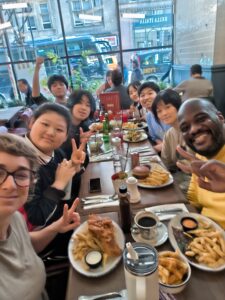
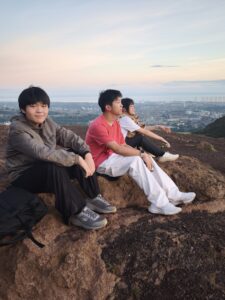
And the city itself was just as captivating as the festival. Edinburgh is a fascinating city with a mix of old and new. We saw Gothic cathedrals, castles, modern sculptures, and outdoor shopping malls. The Gothic architecture, especially the pointed rooftops, blended beautifully with both the night and morning light. The mountains were covered in waves of wheat like grass, rolling in layers at different heights. We walked down the cobblestone street that supposedly inspired Diagon Alley, with its blue-brick houses and uneven stones. On our last day, we climbed to the top of Arthur’s Seat, a mountain to watch the sunrise. The sky turned orange along the edges of the clouds, then a streak of morning light broke through, spreading golden across the land like a mirror. It was a beautiful, almost magical experience that made Edinburgh feel like a gentle European paradise.
At the Fringe, you must go in expecting the unexpected. But what you don’t anticipate is just how much each show will reshape the way you think about theatre.
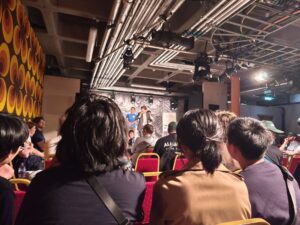
We watched shows that gave us new insight into design—Deckhand turned its set into a character of its own, while Swing Gum made transitions feel like part of the performance, blending visual and auditory storytelling.
We saw new approaches to tension and connection—What’s Next played with suspense like a rubber band stretched to its limit, and Monopoly proved that crowd work isn’t just filler; it’s an art form.
We witnessed acting that stripped everything back—Woyzeck reminded us that realism doesn’t need frills to land, and 2% Milk showed how a creative script can breathe new life into familiar stories.
And we discovered how far the medium can bend—Techies adapted realism into a musical without losing its soul, Elba juggled storytelling techniques with ease, and 1518: The Dancing Plague proved that even a mysterious historical event can be infused with pop culture humor without losing its weight.
At Fringe, you don’t just watch shows. You watch possibilities unfold.
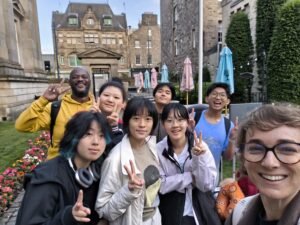
We hope to see Edinburgh Festival Fringe again one day.
For more information about starting your creative journey teaching abroad with BASIS International Schools, visit our careers website.
